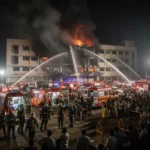
Rescue teams working after the Daryaganj building collapse in Delhi, August 20, 2025.
Loading...
Introduction
When I first read about the Daryaganj building collapse, I felt a mix of shock and sadness. Another tragedy in Delhi—three lives lost, many more affected, and families torn apart. It’s heartbreaking to see such incidents becoming all too common in our city.
On August 20, 2025, around Satbhavana Park, near Ghata Masjid and Ring Road, a building collapsed suddenly, killing at least three workers and injuring others. Rescue teams are still combing through the debris, searching for survivors.
This isn’t just another news story—it’s about lives, families, and a city that continues to face infrastructural challenges.
What Happened in Daryaganj
According to a report by PTI (via multiple outlets), the collapse occurred in the late morning hours. The three deceased workers were identified as Zubair, Gulsagar, and Taufiq.
Several others were injured, with at least three rushed to Lok Nayak Jai Prakash Narayan Hospital (LNJP Hospital) for urgent medical attention. Authorities fear that more individuals may still be trapped beneath the rubble.
Rescue Operations and Immediate Response
The response was quick. Four fire engines and multiple Delhi Police teams reached the site. Rescue operations began immediately, clearing debris and pulling out survivors.
Resource Deployed
Details
Fire Engines
4 units
Police Teams
Multiple
Injured Sent To
LNJP Hospital
Dead Identified
3 (workers)
Delhi Disaster Management Authority (DDMA) was also informed, ensuring that coordinated action could take place.
Victims of the Collapse
The workers who lost their lives were simply doing their jobs. Their names—Zubair, Gulsagar, and Taufiq—shouldn’t just be statistics. These men were fathers, brothers, friends, and breadwinners.
One local resident reportedly said, “They had just gone inside before the collapse. Within minutes, everything was dust and screams.”
Government and Police Response
Delhi Police has stated, “Legal action will be taken after verification of facts.” Investigations are ongoing, and civic authorities have been asked to look into whether the structure was legal, structurally sound, or had ignored safety norms.
This isn’t the first time authorities are reacting after a tragedy. But the real question is: will things actually change this time?
Recent Pattern of Building Collapses in Delhi
What makes the Daryaganj collapse more concerning is that it happened just a month after another deadly collapse.
On July 12, 2025, in Delhi’s Welcome area, an unauthorised four-storey building came crashing down. Six members of one family lost their lives, and at least eight others were injured. That building was in a narrow five-foot lane in Janta Colony, making rescue efforts extremely difficult.
This pattern of recurring collapses suggests a systemic issue in urban planning, construction quality, and building regulation enforcement.
Possible Causes Behind Such Collapses
Based on past experiences and reports, several factors may have contributed to this tragedy:
Illegal or unauthorised construction – Buildings often rise without proper approval.
Poor-quality materials – Cheaper materials are used to cut costs.
Lack of regular inspections – Civic authorities sometimes overlook routine checks.
Overcrowding and age of structures – Old buildings, weakened by years of use, are left standing until disaster strikes.
Voices from the Ground – What Locals Said
When I spoke with people from the area (or rather, read their accounts from local outlets), many expressed anger more than shock.
A shopkeeper near Ghata Masjid said, “We knew the building was weak. We’d warned authorities, but nothing happened. Now three families have lost their loved ones.”
That statement hit me hard. Because if warnings were ignored, this wasn’t just an accident—it was negligence.
Steps Needed to Prevent Future Disasters
It’s easy to say “never again,” but the truth is, without systematic reforms, such tragedies will repeat. Here’s what I think should be done:
Strict enforcement of building codes – No compromises.
Regular safety inspections – Independent audits, not just paperwork.
Accountability of builders and officials – Punishments should be real, not symbolic.
Public awareness – Locals should be encouraged to report unsafe structures.
These aren’t impossible steps. But will the willpower be there? That’s what Delhi must ask itself.
Conclusion
The Daryaganj building collapse is more than a tragic event; it’s a reflection of the fragile state of urban infrastructure in Delhi. We’ve seen it before in Welcome, and sadly, we’ll see it again unless changes are made.
For now, my thoughts go out to the families of Zubair, Gulsagar, and Taufiq. May they find strength in this devastating time. And may Delhi finally learn the lesson it keeps being taught in the harshest way possible.
FAQs
Q1. When did the Daryaganj building collapse happen?
The incident occurred on August 20, 2025, in the late morning hours near Satbhavana Park, Daryaganj.
Q2. How many people died in the collapse?
At least three workers—Zubair, Gulsagar, and Taufiq—lost their lives.
Q3. How many people were injured?
Initial reports confirmed three injured individuals, though more could still be trapped under debris.
Q4. Was the building authorised or unauthorised?
The legality of the building is under investigation by the Delhi Police and civic authorities.
Q5. What measures are being taken to prevent future collapses?
Authorities have promised legal action and stricter enforcement of safety regulations, though systemic issues remain.
Ovais Mirza, a seasoned professional blogger, delves into an intriguing blend of subjects with finesse. With a passion for gaming, he navigates virtual realms, unraveling intricacies and sharing insights. His exploration extends to the realm of hacking, where he navigates the fine line between ethical and malicious hacking, offering readers a nuanced perspective. Ovais also demystifies the realm of AI, unraveling its potential and societal impacts. Surprisingly diverse, he sheds light on car donation, intertwining technology and philanthropy. Through his articulate prose, Ovais Mirza captivates audiences, fostering an intellectual journey through gaming, hacking, AI, and charitable endeavors.
Disclaimer: The articles has been written for educational purpose only. We don’t encourage hacking or cracking. In fact we are here discussing the ways that hackers are using to hack our digital assets. If we know, what methods they are using to hack, we are in very well position to secure us. It is therefore at the end of the article we also mention the prevention measures to secure us.