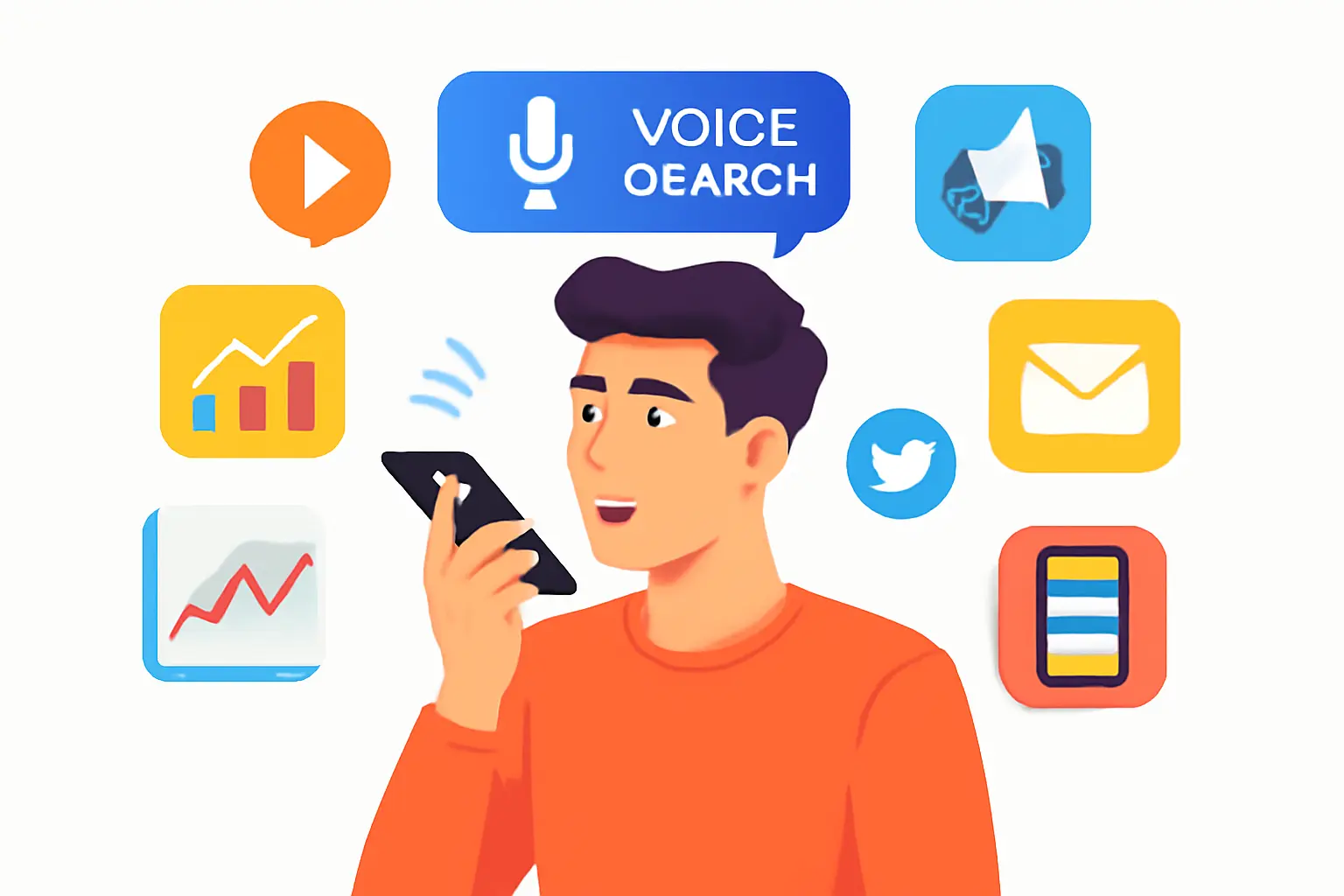
Voice search usage is rising rapidly, transforming how consumers find businesses
Loading...
Introduction
Lately, I’ve noticed myself—and many around me—using voice assistants far more often than typing queries. Whether it’s “Hey Siri, find nearby coffee shops” or “Alexa, play my workout playlist,” voice commands have become part of daily life for millions. This shift isn’t just a passing phase; voice search marketing is rapidly becoming an essential channel for brands to connect with customers.
The Rise of Voice Search: What the Data Says
There’s no denying it: voice search is booming. In the U.S. alone, the number of voice assistant users is expected to hit over 162 million in 2025, with 32% of consumers using voice daily for searches they’d normally type digital silk. Smart speakers aren’t the only devices driving this growth—smartphones lead with 56% of voice searches originating from them.
Nearly 93% of users express satisfaction with their voice assistants, citing convenience and speed as top reasons. What’s more, 40.7% of voice search answers come from featured snippets on Google.
Why Voice Search Marketing Matters to You
If you’re in marketing, listening to this trend can’t be ignored. Voice queries tend to be longer and more conversational than text searches—think: “What are the best vegan restaurants near me?” vs. “vegan restaurants NYC.” This changes the rules of SEO and content strategy altogether.
In addition, voice searches often have strong local intent, so businesses with physical locations stand to gain immensely by optimizing for “near me” queries.
Creating Voice-Optimized Content: Tips and Tricks
Crafting content for voice isn’t rocket science, though it might feel new if you’ve only ever written for text. Here are a few pointers I rely on:
Use Natural Language: Write as if you’re talking to a friend. Keep sentences conversational and clear.
Answer Questions: Focus on FAQs and questions your audience might ask aloud.
Prioritize Featured Snippets: Structured data and concise answers increase chances of being read aloud.
Localize Content: Include location-specific keywords where relevant.
Optimize for Mobile: Remember, most voice searches happen on smartphones.
Tools and Technologies Behind Voice Search
Voice search runs on advancements in artificial intelligence and natural language processing (NLP). Technologies like Google Assistant, Apple’s Siri, Amazon Alexa, and Microsoft Cortana handle billions of voice queries monthly. For marketers, tools like SEMrush, Ahrefs, and AnswerThePublic are invaluable for identifying popular voice search phrases.
Adapting SEO Strategies for Voice Queries
Traditional SEO and voice search SEO overlap but are not the same. Voice search SEO demands a focus on:
Long-Tail Keywords: These reflect full questions or natural phrases rather than short keywords.
Page Load Speed: Voice responses are often instantaneous; slow websites risk losing rankings.
Mobile-First Design: With voice searches predominantly on mobile devices, responsiveness matters.
Featured Snippets & FAQ Pages: Providing clear answers boosts your chances to be the chosen voice response.
Here’s a quick comparison:
SEO Aspect
Traditional SEO
Voice Search SEO
Keyword Style
Short, specific keywords
Long-tail, conversational phrases
Content Format
Broad content, multiple topics
Focused Q&A style, concise answers
User Intent
Varied (informational, transactional)
Mostly informational/local intent
Device Focus
Desktop & Mobile
Primarily Mobile & Smart Devices
Real-Life Anecdotes: Voice Search in Action
One small business owner I know started optimizing for voice queries last year. They tweaked FAQs on their website and added local keywords. Within months, calls from voice search users doubled. Word on the street? Voice search users tend to convert faster since they’re typically closer to making a decision.
Personally, I use voice search daily—sometimes for recipes, other times for quick info while multitasking. The ease keeps me hooked, and I believe many consumers feel the same.
Challenges and Opportunities in Voice Marketing
Like any emerging trend, voice search marketing isn’t without hiccups:
Ambiguity & Misinterpretation: AI assistants aren’t perfect—sometimes they misunderstand accents or context.
Privacy Concerns: Consumers are cautious about devices listening in on private conversations.
Measurement Difficulties: Tracking voice search conversions can be tricky without specialized tools.
However, the opportunities outweigh these challenges. Early adopters gain a significant edge, particularly in competitive local markets and tech-forward sectors.
FAQs
1. How important is voice search for local businesses?
Very important! About 46% of all voice searches have “local intent.” Optimizing for voice can significantly boost foot traffic and calls.
2. Are voice search queries really different from typed ones?
Yes, voice queries tend to be longer, more natural, and use question words like “who,” “what,” and “how.”
3. Can small businesses realistically use voice search marketing?
Absolutely. Local SEO and conversational content can help even small businesses capture voice search traffic.
4. How do I measure the success of voice search marketing?
Using analytics tools that track keyword rankings, click-through rates, and local search behavior can help assess performance.
5. What’s the future outlook for voice search?
Voice search is expected to grow steadily, driven by AI improvements, more smart devices, and younger, tech-savvy generations adopting the technology.
Ovais Mirza, a seasoned professional blogger, delves into an intriguing blend of subjects with finesse. With a passion for gaming, he navigates virtual realms, unraveling intricacies and sharing insights. His exploration extends to the realm of hacking, where he navigates the fine line between ethical and malicious hacking, offering readers a nuanced perspective. Ovais also demystifies the realm of AI, unraveling its potential and societal impacts. Surprisingly diverse, he sheds light on car donation, intertwining technology and philanthropy. Through his articulate prose, Ovais Mirza captivates audiences, fostering an intellectual journey through gaming, hacking, AI, and charitable endeavors.
Disclaimer: The articles has been written for educational purpose only. We don’t encourage hacking or cracking. In fact we are here discussing the ways that hackers are using to hack our digital assets. If we know, what methods they are using to hack, we are in very well position to secure us. It is therefore at the end of the article we also mention the prevention measures to secure us.